BILLS & MONITORING
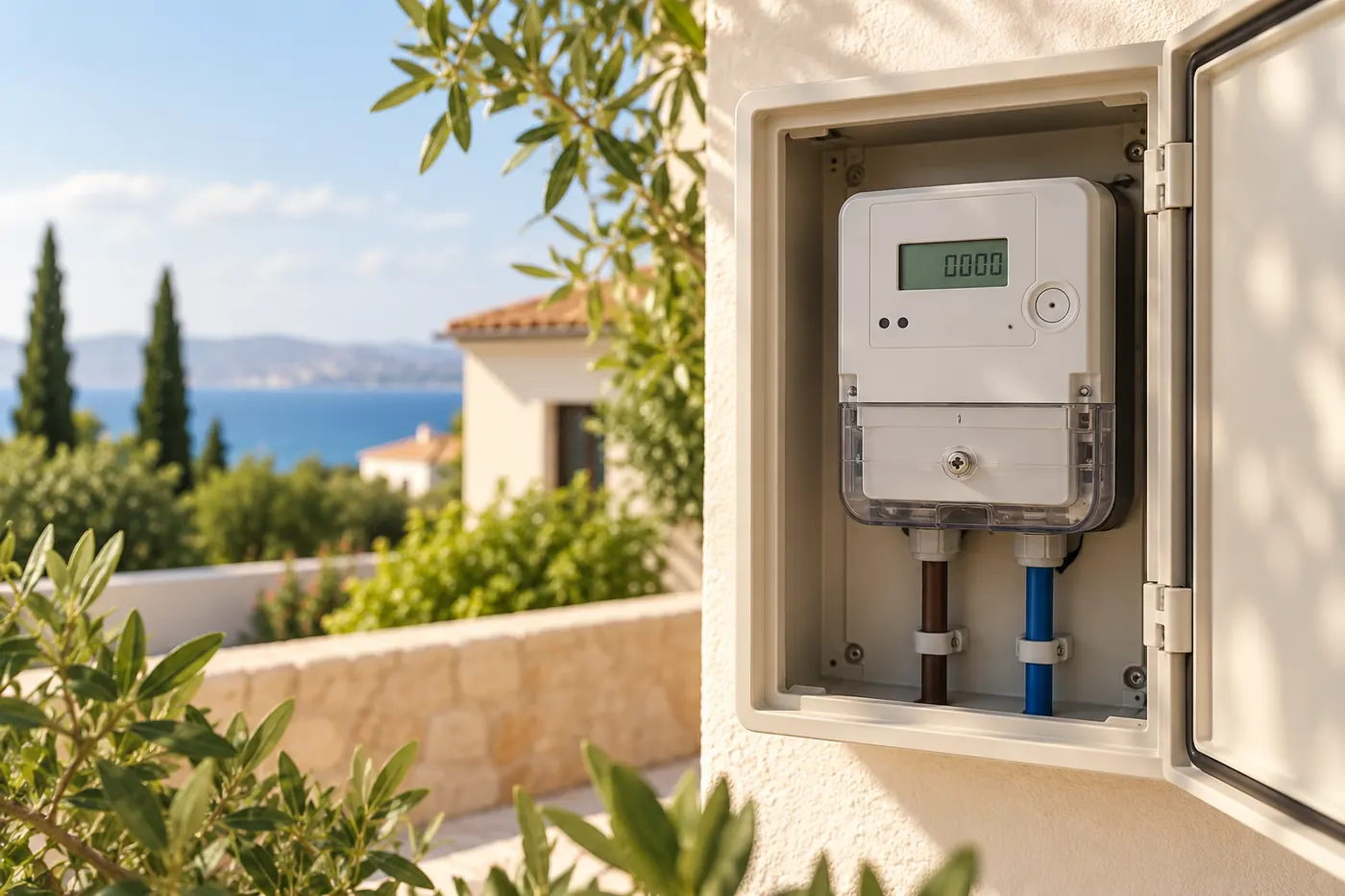
Reading your EAC smart meter when you have solar and storage
Understand import, export and solar production: which readings to record and how to compare an EAC smart meter with your inverter and battery app.
The short answer
The meter records electricity crossing the property’s grid connection. Import and export are not the same as total solar production, and a home battery adds a further flow that must be read in the inverter or storage monitoring.
Read the code as well as the number
On the smart meter described in the EAC manual, OBIS 1.8.0 is the cumulative incoming-energy register and 2.8.0 is the outgoing-energy register. These are energy totals in kWh. They are not the power of the installation and not a measurement of every kWh produced on the roof.
Use the manual for the installed meter. Record the displayed code, value, date and time together. A photograph of a large number without its register code can be difficult to interpret later.
Compare changes over the same period
A cumulative register is useful when you take two readings. If import rises from 1,240 to 1,258 kWh, the increase is 18 kWh. If export rises from 820 to 831 kWh over the same interval, export is 11 kWh. Neither total can be compared sensibly with an inverter figure from different dates.
Create a simple record with four fields: period, imported kWh, exported kWh and inverter production. Add battery charge, discharge and state of charge if available. Keep the original screenshots so an installer can investigate a mismatch.
Why the battery changes the explanation
For a system without storage, generation minus export can help estimate on-site solar use, subject to consistent measurement points and losses. With a battery, the explanation also needs energy moved into storage, energy returned later, losses and the change in stored charge.
For example, daytime production may charge the battery while the home draws little power. The same stored energy can serve the home after sunset. Treating battery charging as immediate household consumption, then adding discharge again, would count energy twice.
From readings to a bill
Do not multiply every exported kWh by an assumed retail tariff. The applicable agreement determines the value and timing of any credit. A change of display or meter should not be used as evidence that your particular commercial terms have changed.
The UNLIMITED calculator separates self-use, current-period export offset and carried credit using the scenario shown in its methodology. Those figures are planning assumptions; use your bill and contract when assessing an installed system.
A useful request for a performance review
- Send matching-period bill, meter and inverter records.
- State whether storage or an EV was added during the period.
- Identify the question: higher imports, lower production or an unexpected credit.
- Ask which measurement or setting will establish the cause.
Use our system review and upgrade route for an existing installation. Read the display only; leave electrical work and sealed meter equipment to authorised personnel.
Sources and further reading
Related source topic: Smart Solar Cyprus — EAC Smart Meters in Cyprus: What Solar Owners Should Know (2026-10-26).
An original UNLIMITED guide, informed by the linked sources. Source publication dates and our update date are different.
Check programme status and property-specific terms in the linked official sources before making a decision.
Keep exploring

Will the panels fit? Roof space and module size explained
Panel watts, physical dimensions and usable roof area are different. Learn what a useful Cyprus roof layout should show before you compare proposals.
Read the guide
Solar at another property: what to check before virtual bill offsetting
Understand the idea of virtual solar credits and the contract, connection and site checks needed before assuming a remote system can offset your Cyprus bill.
Read the guide
Before adding panels or a battery: check your solar system documents
A practical Cyprus checklist for an existing solar system: approved configuration, inverter, battery compatibility and the next steps before an upgrade.
Read the guide